







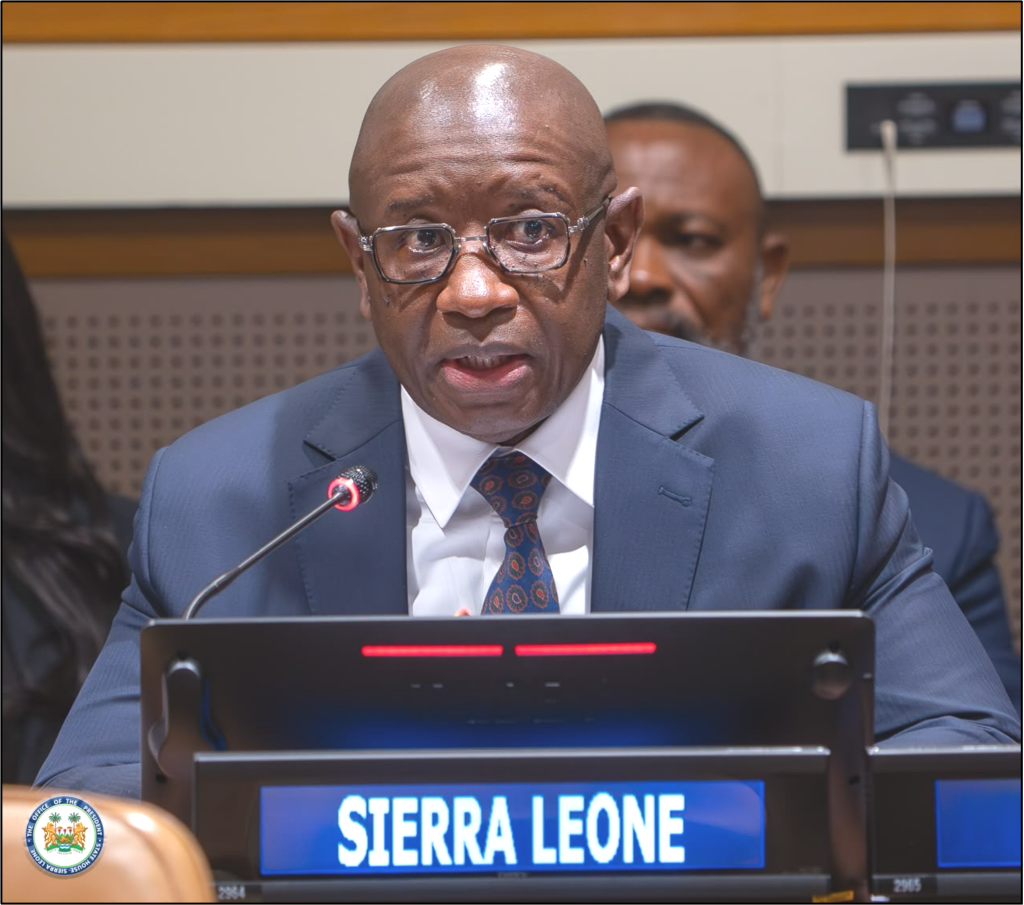
Sierra Leone’s President, Dr Julius Maada Bio, has cautioned African nations against repeating historical patterns of economic extraction in the era of artificial intelligence. He spoke at a roundtable hosted by Kenyan President William Ruto during the 80th United Nations General Assembly.
Addressing fellow leaders and experts, President Bio emphasised the need for Africa to actively participate in shaping the technologies that will redefine the global economy. “Will Africa be a passive recipient of artificial intelligence systems built elsewhere, or will it actively shape the infrastructure and regulatory rules that dictate value creation and distribution?” he asked. He asserted that no single African nation can develop the entire AI infrastructure alone but insisted that Africa should not let others dictate its digital future.
He proposed a concept of “shared sovereignty,” where African countries would develop what they can independently while forming partnerships for larger projects. This approach aims to protect national assets and collaborate with external partners on terms that prioritise African interests. It would enable countries to share resources while maintaining control over key national issues.
President Bio pointed out Africa’s significant infrastructure deficit, highlighting that the continent comprises about one-fifth of the global population but holds only a small fraction of the world’s data centre capacity. He warned that this imbalance could lead to Africa becoming merely a supplier of raw materials while others benefit from developing and monetising valuable technologies.
Sierra Leone, with backing from the World Bank Group, is already creating its first national AI strategy, according to President Bio. He emphasised the need for practical solutions to local challenges, stressing that effective AI must operate in the real world—compatible with mobile phones, effective in low-bandwidth situations, and able to understand African languages and cultural contexts. “Can a farmer gain more insights into his crops? Can a healthcare worker make better choices? Can these tools aid teachers in helping their students?” he asked.
He also suggested innovative regional arrangements for data hosting, proposing the concept of regional data embassies to ensure that critical public data is securely managed in a partnering state. “Sovereignty should move with the law, not just the building,” he stated.
President Bio further warned against reverting to extractive economic practices. He highlighted the importance of investing in African talent, research, languages, and innovation ecosystems to ensure that the continent does not export raw materials whilst importing value. His goal is to shift from “mine to model,” enabling African countries to play a significant role in the value chain, moving from raw material extraction to the creation of technology and services.
He urged African nations to proactively engage in establishing global AI regulations rather than waiting for decisions to be made elsewhere. Collaboration on data governance, capacity building, safety, and regulatory frameworks is essential, he noted.
President Bio invited governments, investors, and businesses to continue discussions at the inaugural West Africa Integration and Investment Summit on 17-18 November 2026 in Sierra Leone, where practical frameworks for shared AI sovereignty could be developed. “Let’s take what we discuss here in New York and start testing it in Freetown,” he suggested.
In conclusion, he affirmed that sovereignty should not represent isolation, but the autonomy to select and shape how countries engage globally. He expressed commitment to shared sovereignty with other nations to ensure that Africa does not leave future generations with a legacy of diminished data rights and economic potential.


