


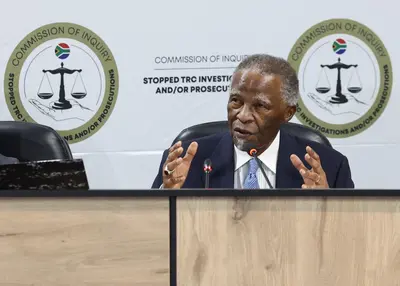
Former South African President Thabo Mbeki has rejected allegations of political interference in the prosecutions recommended by the Truth and Reconciliation Commission (TRC). He stated that the National Prosecuting Authority (NPA) is solely responsible for the failure to resolve numerous cases that have remained unprosecuted for years.
The judicial commission of inquiry was established last May, chaired by retired Constitutional Court Justice Sisi Khampepe, with assistance from retired Northern Cape Judge President Frans Diale Kgomo and Advocate Andrea Gabriel SC. This followed an application from families and victims of apartheid-era crimes in the Gauteng Division of the High Court.
Among those affected are the families of the Cradock Four—Matthew Goniwe, Sicelo Mhlauli, Fort Calata, and Sparrow Mkonto—who were murdered for their anti-apartheid activism. They are seeking declaratory orders and damages from the NPA for its failure to act on the cases identified by the TRC.
In a speech to Parliament on 15 April 2003, Mbeki indicated that it was up to the National Director of Public Prosecutions and intelligence agencies to handle early prosecutions. He clarified that the individuals who applied for amnesty under the TRC but were denied do not fall under the same categories he mentioned.
Mbeki maintained that the NPA must take charge of any cases relating to those denied amnesty, stating, “I deny the allegations” regarding the claims of political interference.
He also dismissed accusations that he held secret discussions with former President FW de Klerk and members of the South African Defence Force and Police about granting amnesty to those involved in apartheid-related crimes. Mbeki challenged comments made by Lukhanyo Calata, Fort Calata’s son, that both the government and the ANC have let down TRC victims and their families.
In a radio address in 1985, marking the funeral of the Cradock Four, Mbeki referred to them as “heroic martyrs” of the anti-apartheid struggle, saying that their sacrifice would never be forgotten as they remained “warriors of the people’s cause.”


