







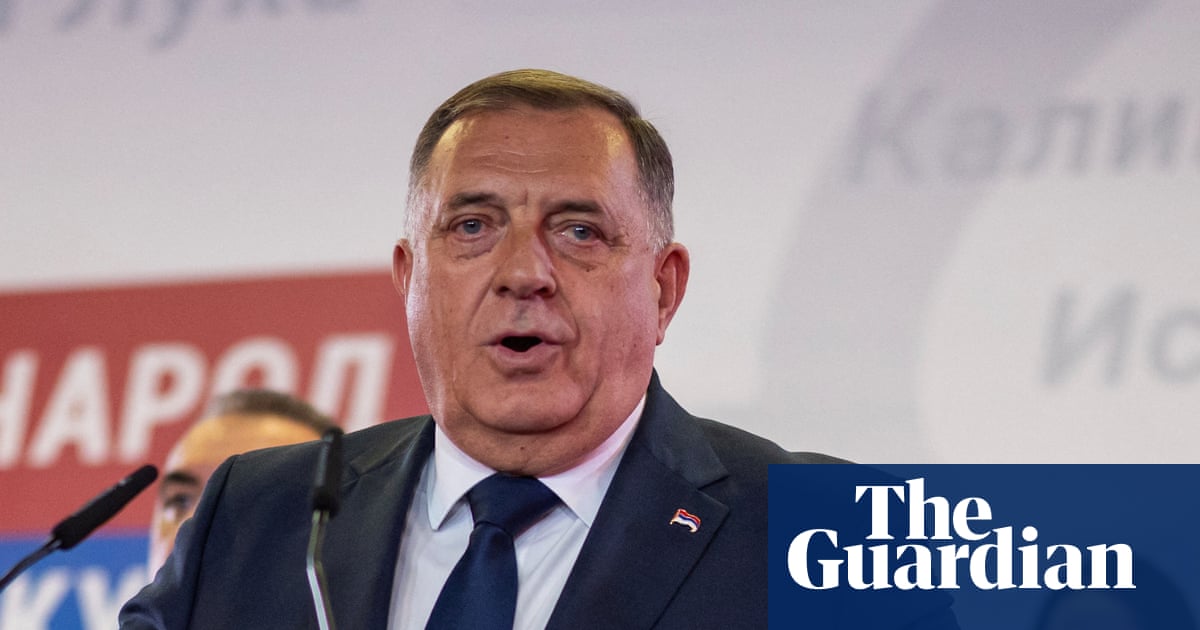
Milorad Dodik, a Bosnian Serb nationalist politician, has claimed victory for his party in Bosnia’s recent elections, which were influenced by economic strain, EU membership prospects, and ongoing ethnic tensions stemming from the 1992-95 war.
Dodik, a strong supporter of Russia who did not appear on the ballot, dominated the campaign with separatist rhetoric, raising concerns about renewed instability in the country. Formerly the president of Republika Srpska, he was barred from public office after being convicted last year of defying a decision by the international envoy overseeing the peace agreement.
With nearly 90% of votes counted, Dodik’s ally, Željka Cvijanović, from the Alliance of Independent Social Democrats, secured over 55% of the votes for one of the three seats in the tripartite presidency, leading her closest rival by around 30 percentage points. At a news conference, Dodik announced that their party would also maintain a “vast majority” in Republika Srpska’s assembly, crediting the outcomes to support from world leaders, including Donald Trump and Vladimir Putin. “No one should ask us to change our politics,” he stated. “We will not give up, but continue for our people … I cannot believe that we smashed it like this.”
Approximately 3.4 million citizens were eligible to vote for the three members of the multi-ethnic presidency and for lawmakers in the national parliament. Voter turnout was reported at 42%, a decline of 8% from the last election in 2022.
Dodik has long tested the limits of Bosnia’s governance established by a US-brokered agreement, often defying the national government and pushing for Republika Srpska’s separation. At his final election rally in Banja Luka, he asserted, “Bosnia is dead,” reinforcing his divisive stance. Both Darijana Filipović from the Croatian Democratic Union and the current Bosniak presidency member Denis Bećirović declared their victories before all votes were counted.
Analysts suggest that despite Dodik’s absence from the ballot, his influence remains significant. “It is obvious that these measures to ban him from political life are not working, and he is using them,” noted analyst Dragan Bursać.
Bosnia, one of Europe’s poorest nations, continues to struggle with the remnants of war, which claimed over 100,000 lives and displaced millions. The conflict’s legacy gained renewed attention recently following tributes to wartime army commander Ratko Mladić, who passed away in August while serving a life sentence for genocide.


