If you’ve been researching Sierra Leone and keep finding the same recycled copy about beautiful beaches and friendly people, this is for you. The real Sierra Leone is stranger, more complex, and far more interesting than any of that.
Here’s what the country is actually like, from someone who’s spent years there.
There Are No Lions in Sierra Leone
Start with the name. Most people assume it means something like “land of lions” and picture a savanna teeming with big cats. The name actually comes from a Portuguese explorer called Pedro de Sintra, who sailed past in 1462 and named the peninsula Serra Lyoa, meaning roughly “Lion Mountain.” Some historians think he was describing the shape of the hills. Others think it was the sound of thunder rolling through them during a storm. Either way, there haven’t been lions in Sierra Leone in any recorded period of history. The country is named after something that was never there.
It’s a small thing, but it tells you something about how the country has always been slightly misunderstood from the outside.
Freetown Was Built by People Escaping Slavery
This one hits differently when you’re standing in the city and you actually know it. Freetown wasn’t founded by the British in the usual colonial sense. It was established in 1787 as a settlement for freed slaves, Black loyalists from Nova Scotia, and Maroons from Jamaica, people who had either been liberated or who had fought their way free from plantation systems in the Americas. They landed on this steep, forested peninsula and built a city.
The name wasn’t incidental. It was a statement.
In the centre of Freetown, there’s a massive cotton tree, a ceiba, hundreds of years old, that those first settlers reportedly gathered beneath to pray when they arrived. It’s not a monument or a museum piece. It sits in the middle of a busy road junction with traffic circling around it and market traders working in its shade. You drive past it on your way somewhere else and occasionally you have to stop and think about what you’re looking at.
Sub-Saharan Africa’s First University Was in Freetown
Fourah Bay College was founded in 1827. That’s before most of West Africa had any formal higher education infrastructure at all, and before many European universities as we know them today even existed in their modern form. It became affiliated with Durham University in 1876 and for most of the 19th century it was called “the Athens of West Africa,” which sounds like overstatement until you realise how many doctors, lawyers, and politicians educated there went on to shape the whole region.
The college still exists. It’s up on a hill above Freetown with views over the peninsula that are, honestly, difficult to describe without slipping into the kind of language I’m trying to avoid here. Let’s just say it’s a very good view.
The Rain Doesn’t Behave Like You Think Rain Should
Freetown gets somewhere around 3,500 to 4,000 millimetres of rainfall a year. For context, London gets about 600. During peak rainy season, roughly July and August, it doesn’t just rain. It comes down with a kind of commitment that feels almost aggressive. The streets flood within minutes. The red laterite dirt turns to a kind of thick orange paste that gets into everything. The sound on a tin roof is so loud you can’t hear the person next to you.
I’ve sat in rooms during a proper downpour and watched the light outside go from afternoon to almost dark in fifteen minutes, just from cloud cover. It’s genuinely dramatic. If you’re visiting and you haven’t factored the rainy season into your plans, you’ve made a mistake. Some roads become impassable. Some places genuinely disconnect from the rest of the country. Plan around it or accept that it’s going to change your plans anyway.
The Country Is About 70% Muslim and Genuinely Doesn’t Make a Big Deal About It
This surprises people, partly because Sierra Leone doesn’t dominate conversations about Islam in West Africa the way Senegal or northern Nigeria does. But the more surprising part isn’t the statistic. It’s what it looks like in practice.
Christians and Muslims in Sierra Leone attend each other’s celebrations. A Muslim family will have Christmas lunch with their Christian neighbours. Christian colleagues fast in solidarity during Ramadan. Intermarriage between the two faiths is common. Pew Research has noted Sierra Leone as one of the most religiously tolerant countries they’ve tracked, and from what I’ve seen, that’s not spin. It reflects something genuinely embedded in daily life there.
I’m not saying it’s without tension, and I’m not saying it’s a model for anywhere else. I’m just saying that if you go expecting to find religious division, you’ll be confused.
The Diamonds Nearly Destroyed the Country
Sierra Leone has some of the richest alluvial diamond deposits in the world. You can find gem-quality stones in riverbeds and fields, not deep underground, just sitting there in the gravel if you know where to look. That sounds like extraordinary luck. For a long time, it was the opposite.
The civil war that ran from 1991 to 2002 was partly funded by diamond smuggling. The RUF, the rebel group responsible for some of the most horrific atrocities of the conflict, controlled diamond-producing areas and traded the stones for weapons. The term “blood diamonds” became widely known because of Sierra Leone. The film by that name, whatever you think of it as a film, isn’t wildly inaccurate about the basic mechanics of how it worked.
The war ended over twenty years ago. The diamond industry is better regulated now. But if you drive through the diamond districts in the east, you see men waist-deep in hand-dug pits, sifting gravel by hand with wooden sieves, and you understand that the wealth in the ground never really reached most of the people doing the digging.
There Are Chimpanzees About 30 Minutes from the Capital
Wild chimpanzees live in the forests of the Freetown Peninsula, and the Tacugama Chimpanzee Sanctuary sits about 30 kilometres outside the city in the Western Area Forest Reserve. It rescues chimps that have been taken from the wild and kept as pets, usually after their mothers were killed. They can’t be released back into the wild after that much human contact, so the sanctuary is a permanent home for them.
You can visit. The chimps are loud, occasionally unsettling, and completely fascinating to watch. The forest around the sanctuary smells of damp earth and something sharper underneath it, that particular green smell that hits you before you’ve even opened the car door. Going there is one of the most worthwhile things you can do within easy reach of Freetown and almost nobody who visits the country seems to know it exists.
Krio Is an English Based Language That Makes No Sense Until Suddenly It Does
The lingua franca of Sierra Leone is Krio, a creole language that evolved from the speech of freed slaves and their descendants. It’s technically descended from English, and if you’re a native English speaker you’ll understand maybe 40% of it when you first hear it. That 40% is enough to be genuinely disorienting, because your brain keeps trying to catch hold of it as English and failing.
“Ow di bodi?” means “how are you?” “I beg” means “excuse me” or “please.” “Pikin” means a child. “Na so” means “that’s right.” Once it starts clicking it’s an absolute joy to listen to. It’s also, if you think about it, a living linguistic record of one of the most significant forced migrations in human history, which is a strange and moving thing to be ordering lunch in.
Here’s a Krio language resource for beginners that you might find useful.
The Civil War Left Marks That Are Still Visible
The war ended in 2002. If you’re visiting now, that’s over two decades ago. But Freetown still carries it. There are amputees in the city, men and women who had limbs removed by rebels as a deliberate terror tactic, and they’re not hidden or institutionalised. They’re part of the city. You’ll see them at traffic junctions, in markets, going about their lives. It can be confronting if you weren’t expecting it.
There are also buildings in Freetown that were damaged during the war and never fully repaired. Not because people forgot, just because resources are finite and other things were more urgent. The country didn’t get the kind of international reconstruction funding that might have made a visible difference to the infrastructure. You feel that gap sometimes.
The Beaches Would Be Famous If They Were Anywhere Else
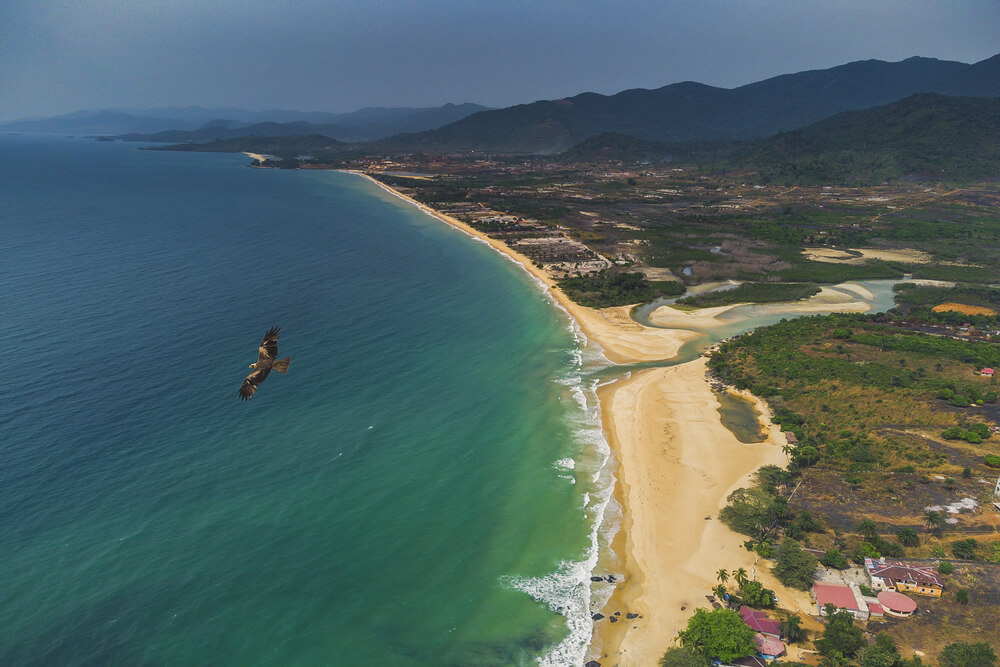
I’ll say this plainly. River No. 2 Beach, Tokeh, John Obey, Bureh Beach. If these were in Thailand or Portugal or anywhere with a functional tourism industry, they would be full of sun loungers and Instagram posts and overpriced cocktails. They’re not. They’re mostly empty. The water is warm, the sand is the colour of pale caramel, and on a clear morning the light on the Atlantic is something you don’t forget.
Sierra Leone gets a fraction of the visitors that neighbouring countries do, for reasons that are partly about infrastructure and partly about perception. The country had Ebola cases in 2014 and 2015, and it never fully recovered its reputation with cautious travellers, even though the outbreak ended a decade ago. That’s genuinely unfair. But it does mean the beaches are quiet.
The Country Has Two Wet Seasons and One of Them Will Ruin Your Plans
Actually, I should be clearer about this than I was earlier. Sierra Leone has a rainy season and a dry season, but the transition between them, April to May and then October to November, is its own thing entirely. Unpredictable in a way that the main rainy season isn’t. Roads that were passable a week ago become rivers. Boats that ran regularly stop running. If you’re visiting in that shoulder period, you need to build flexibility into whatever you’re doing, because Sierra Leone’s transport infrastructure isn’t forgiving when it gets wet.
The harmattan, the dry dusty wind that blows down from the Sahara in December and January, is its own surprise. You’ll wake up to haze and a fine layer of dust on everything, and the light goes flat and orangey. It’s atmospheric but it’s also genuinely drying, and your throat will know about it by day three.
It’s One of the Most Religiously Tolerant Countries in the World and Nobody Talks About That
I mentioned this earlier in the context of the Muslim majority, but it deserves its own moment because it’s genuinely one of the most distinctive things about the country and it’s almost never mentioned in anything written about Sierra Leone.
While much of the world argues about religious coexistence as an ideal, Sierra Leone has been practising it quietly for generations. The government has historically included members of both faiths at senior levels. National holidays from both religions are officially recognised. The social fabric in most communities treats religious difference as unremarkable.
That doesn’t mean the country has solved everything. It hasn’t. But on this particular thing, it has something that a lot of richer, more powerful countries are still trying to figure out.
If You’re Going, Go With Your Eyes Open
Sierra Leone isn’t easy. The infrastructure is genuinely hard in places. The healthcare system has gaps that matter. The roads will test you. Some things won’t work the way you expect them to.
But it’s also the kind of place that stays with you in a way that easier destinations don’t. The history alone is enough to fill a week of thinking. The people you’ll meet, if you get beyond the surface, tend to be warm and direct in a way that’s rarer than you’d think, and those beaches really are as good as I said.