If you grew up in Sierra Leone or spent enough time there to actually get it, you already know. And if you know, you know you’ve been trying to explain these things to outsiders for years and failing completely. This one’s for you.
EDSA Has “Taken Light” and Somehow It’s Fine
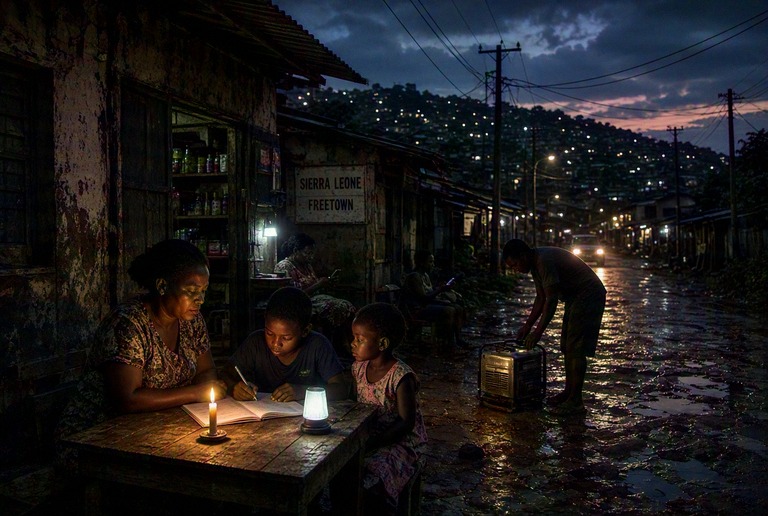
The electricity authority has a name. It’s EDSA. But across Freetown and beyond, it’s better known by the sentence it inspires dozens of times a week: “EDSA has taken light.” Not “the power’s out.” Not “there’s a blackout.” EDSA has taken the light. As if it walked into your house, looked your light bulb in the eye, and carried it off somewhere personal.
What nobody outside Sierra Leone quite grasps is how completely life reorganises itself around this. You don’t panic. You don’t call anyone. You locate your phone by feel in the dark, check how much battery you’ve got left, calculate whether the generator’s worth starting for two hours, and carry on your conversation without missing a word. Candles appear from nowhere. Children do homework by phone torch. Dinner still gets cooked.
The generator is its own subculture. There’s the negotiation over whether it’s worth starting. The argument about fuel. The neighbour whose generator is slightly louder than everyone else’s and who starts it at eleven at night. You’ve slept through that generator. You didn’t even notice it stopped.
The Rain Is Not Rain, It’s a Personal Attack
People who haven’t been to Freetown in rainy season think they understand rain. They do not understand rain. They understand drizzle with ambition.
Sierra Leone gets some of the highest rainfall in West Africa, and during the rainy season, from around May through October, the sky doesn’t open, it collapses. In fifteen minutes, roads become rivers. Actual rivers. People wade through water that reaches their knees on streets they walked dry an hour ago.
The thing that outsiders don’t get is that life doesn’t stop for this. You weren’t going to cancel your plans. You just watch the rain, make a rough calculation, and at some point decide to go anyway. You’ll arrive soaked. Everyone else will arrive soaked. Nobody mentions it. You shake the water off your jacket and pick up exactly where you left off.
And the smell of that rain hitting hot earth, that particular heavy sweetness that hits you before the first drop even lands, that’s a smell Sierra Leoneans carry in their memory forever, wherever they end up in the world.
Poda Poda: The Commute That Builds Character
There’s public transport, and then there’s the poda poda. It’s a minibus, technically. In practice, it’s a masterclass in human endurance, community tolerance, and creative spatial thinking.
The driver will fit more people into that vehicle than you thought physics would allow. Someone will have a live chicken. The music will be whatever the driver feels like at full volume, and it will change without warning. You’ll be pressed against a stranger on one side and a window that doesn’t quite close on the other, and outside, Freetown will be doing its thing, traffic moving in what looks like chaos but somehow isn’t.
Here’s what nobody tells you: there’s a whole social code in there. You don’t just shove your way on. There are unspoken rules about who sits where, how you pass fares forward, how you signal your stop. Get it wrong and you’ll know from the looks. Get it right and you’re just another person getting where they need to go, the same as everyone else.
Time Is Flexible, and That’s Not a Criticism
A wedding that starts at three o’clock does not start at three o’clock. This is not a surprise to anyone attending. The invitation says three. The guests hear “sometime this afternoon, dressed and ready.” Four-thirty is early. Five is reasonable. Six is when things get properly started.
The outsider’s mistake is treating this as disorganisation. It isn’t. It’s a different relationship with time entirely, one that assumes people have lives and distances and generators that didn’t start and roads that flooded. Building that flexibility in isn’t laziness. It’s courtesy, in its own way.
Actually, I should say this more clearly: if you show up to a Sierra Leonean event on time and it hasn’t started yet, nobody is embarrassed except you. Get a plate of food, find someone to talk to, and let the afternoon settle into itself. That’s how it works and honestly, once you’ve stopped fighting it, it’s one of the most relaxing things in the world.
Cassava Leaf Is the Answer to Every Question
Sad? Cassava leaf. Celebrating? Cassava leaf. Can’t decide what to cook? The question answers itself. Sierra Leone’s national dish shows up at funerals, at parties, at Sunday lunch, at Tuesday lunch, at any lunch. It’s slow-cooked, deeply savoury, slightly earthy, and served over rice because of course it is. The smell of it cooking low on the stove for hours is the smell of home.
What makes it funny, and painfully true, is the reaction when a Sierra Leonean abroad makes cassava leaf for the first time in months. The whole situation becomes an event. People appear from nowhere. The cooking takes most of the day. Everyone pretends they weren’t waiting for this but they absolutely were.
You can try to explain it to someone who’s never had it. You can say it’s greens cooked down with palm oil and smoked fish and groundnuts and meat, and they’ll nod, and they still won’t understand why you lit up when you said the words. You just have to feed them some and wait for their face to change. That’s the only explanation that works.
There’s a specific kind of pride that comes with being from a place that most of the world can’t find on a map, and still knowing, deep in your bones, that it gave you something they don’t have. Sierra Leoneans carry that around quietly. Until someone mentions cassava leaf or EDSA or the rainy season, and then not so quietly.