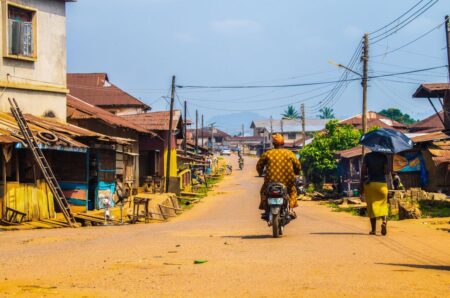
If you’re asking this question, you’re probably trying to figure out whether Sierra Leone is a place worth betting on, whether that’s your money, your start up, your remote work setup, or your next five years. The honest answer isn’t a straight yes or no. It’s more complicated than the optimists want you to believe and more promising than the sceptics will admit.
What “Digital Economy” Even Means Here
When people in Freetown talk about the digital economy, they’re not always talking about the same thing. You’ve got government officials using it to mean e-governance and mobile tax collection. You’ve got young entrepreneurs using it to mean apps, freelancing, and crypto. You’ve got foreign investors using it to mean fintech opportunity in an underbanked population of eight million people.
All of them are right. None of them is the full picture.
The Sierra Leone digital economy conversation tends to happen in conference rooms and at start up events while outside the window, someone is trying to load a webpage on a 3G connection that keeps dropping. That gap between the conversation and the reality is the most important thing to understand before you do anything else.
The Infrastructure Problem Nobody Wants to Lead With
Internet access in Sierra Leone is real. It exists. But it’s expensive relative to income, inconsistent outside Freetown, and the power situation makes everything harder than it needs to be. Load shedding is a way of life. You get used to building your day around when the electricity is on and when it isn’t. Generators run on petrol that costs money. Solar setups help but they’re not universal.
In Freetown itself, you can get decent 4G in the centre and in parts of the west. Go east, and it gets patchier. Step outside the capital and you’re largely looking at 2G or 3G in the better-connected towns, and nothing reliable in the provinces. I’ve sat in Bo, Sierra Leone’s second city, trying to make a video call and watching it fail three times before I gave up and sent a voice note instead.
Fibre is coming. There’s been talk of the ACE submarine cable improving things, and the government has made digital infrastructure a stated priority. But “coming” and “here” are different things, and in Sierra Leone the gap between policy and delivery tends to be wide.
Where Mobile Money Changed Everything
Here’s what does work, and works well. Mobile money. Orange Money, Afrimoney, and a few others have transformed how ordinary people handle transactions. Street vendors accept it. Landlords take rent through it. Market women who’ve never had a bank account move money daily through their phones.
This isn’t theoretical. Walk through the markets in Freetown and watch it happen. Someone buys a bag of rice, taps a few buttons, done. It’s faster than cash in a lot of situations and it’s genuinely embedded in daily life in a way that took years to build but is now solid.
That foundation matters enormously for any serious conversation about Sierra Leone’s digital economy. Mobile money is the rails that everything else can run on. It’s arguably the most significant digital transformation the country has gone through, and it happened quietly, driven by necessity rather than any grand plan.
The Start up Scene, Honestly Assessed
There is a start up ecosystem in Freetown. It’s small, it’s scrappy, and parts of it are genuinely exciting. Innovate SL and a few incubators have done real work supporting early-stage founders. There are young Sierra Leoneans building products, not just dreaming about them.
But the constraints are real. Access to funding is limited. Most venture capital with African mandates is looking at Lagos, Nairobi, Cairo, and Accra first. Sierra Leone doesn’t have the deal flow or the ecosystem depth to compete with those markets yet, and anyone who tells you otherwise is selling you something.
The founders who are making it work are mostly doing it by being extremely resourceful and by solving problems that are specific to Sierra Leone and the immediate region. The ones who struggle are often trying to copy a model that worked in a better-resourced market and wondering why it doesn’t translate.
Actually, I should mention something before I move on: the talent pool here is more sophisticated than people expect. Sierra Leoneans who came up through the war period and built lives through sheer grit have a problem-solving mentality that you can’t teach in a business school. The issue isn’t capability. It’s the structural stuff: power, connectivity, finance, regulation.
What the Government Is Actually Doing
The government has been pushing digital transformation with more seriousness in recent years than at any previous point. The Directorate of Science, Technology and Innovation has been active. There’s been movement on e-government services, digital ID infrastructure, and attempts to streamline business registration online.
Some of this is genuine progress. Business registration has genuinely gotten easier than it was five years ago. The digital national ID rollout, though slow and imperfect, is building a foundation that matters for financial inclusion and service delivery.
Some of it is performative. You’ll attend a conference and hear a minister give a speech about Sierra Leone becoming a digital hub for West Africa, and then you’ll try to renew a document through the government portal and spend a morning going in circles. The ambition and the execution are still some distance apart.
For context, the World Bank’s Digital Economy for Africa initiative has included Sierra Leone in its work, and the country has received support for broadband infrastructure and digital financial services. That external pressure and funding does move things, slowly but measurably.
Is This a Good Place to Run a Remote Business or Work Remotely?
If you’re asking whether you can base yourself in Sierra Leone and run a remote business, the answer is yes, but with conditions. Freetown is workable. Get yourself a good local SIM with a data plan, a backup router or dongle from a different network, a UPS for your devices, and ideally access to somewhere with a generator. That’s just the baseline setup.
Co-working spaces exist in Freetown. They’re not numerous but they’re functional, they’ve got backup power, and they put you around other people doing similar things. The community of remote workers and digital professionals is small but it’s real and it’s connected.
The cost of living is lower than London or any major European city, obviously. But it’s higher than people expect for West Africa, because a lot of things are imported and the logistics of getting them here add cost. You won’t be living cheaply on a European budget. You’ll be comfortable.
The Skill Gap and the Education Question
One of the biggest constraints on Sierra Leone’s digital economy isn’t infrastructure or policy. It’s skills. There aren’t enough trained developers, data people, or digital marketers relative to the demand that exists. The universities have historically been slow to update curricula. Coding bootcamps and short courses have tried to fill the gap and some have done decent work, but the numbers are still small.
This is also an opportunity, if you look at it that way. Anyone willing to invest in training programmes here is operating in a market that’s wide open. I’ve seen organisations that committed to building local talent actually get something back in loyalty and quality that they couldn’t have found by hiring transient contractors. Sierra Leoneans who get proper training and genuine opportunity don’t tend to leave in a hurry.
The Honest Verdict on Sierra Leone’s Digital Readiness
Sierra Leone is not ready for a digital economy in the way that the phrase usually implies: a smooth, reliable, accessible digital environment where businesses can operate, citizens can access services, and entrepreneurs can build without fighting the infrastructure every day.
But it’s further along than people think, and moving in the right direction. Mobile money is real. There’s a generation of young people who understand technology and want to build things. There’s political will, even if execution lags. There’s international attention and funding going into the sector.
The opportunity is real for people willing to work within the constraints rather than pretend they don’t exist. The trap is going in with the wrong expectations, either the rose-tinted version sold at conferences or the dismissive version from people who’ve never spent real time here.
Sierra Leone’s digital economy isn’t arriving all at once. It’s being built in pieces, in the markets where mobile money flows, in the small offices where founders are figuring it out, in the schools where a teacher shows a student something on a phone they’ll never forget. That’s how it happens. Not all at once, but it happens.
The GSMA’s Mobile Economy Sub-Saharan Africa report gives useful regional context if you want to understand where Sierra Leone fits in the broader picture. It’s not the whole story, but it’ll give you numbers to work with.
If you’re thinking seriously about being part of it, my honest advice is this: go with patience, go with a realistic budget, go with a plan that works in the current conditions rather than the conditions you wish existed. And go soon, because in five years this conversation is going to look quite different.