





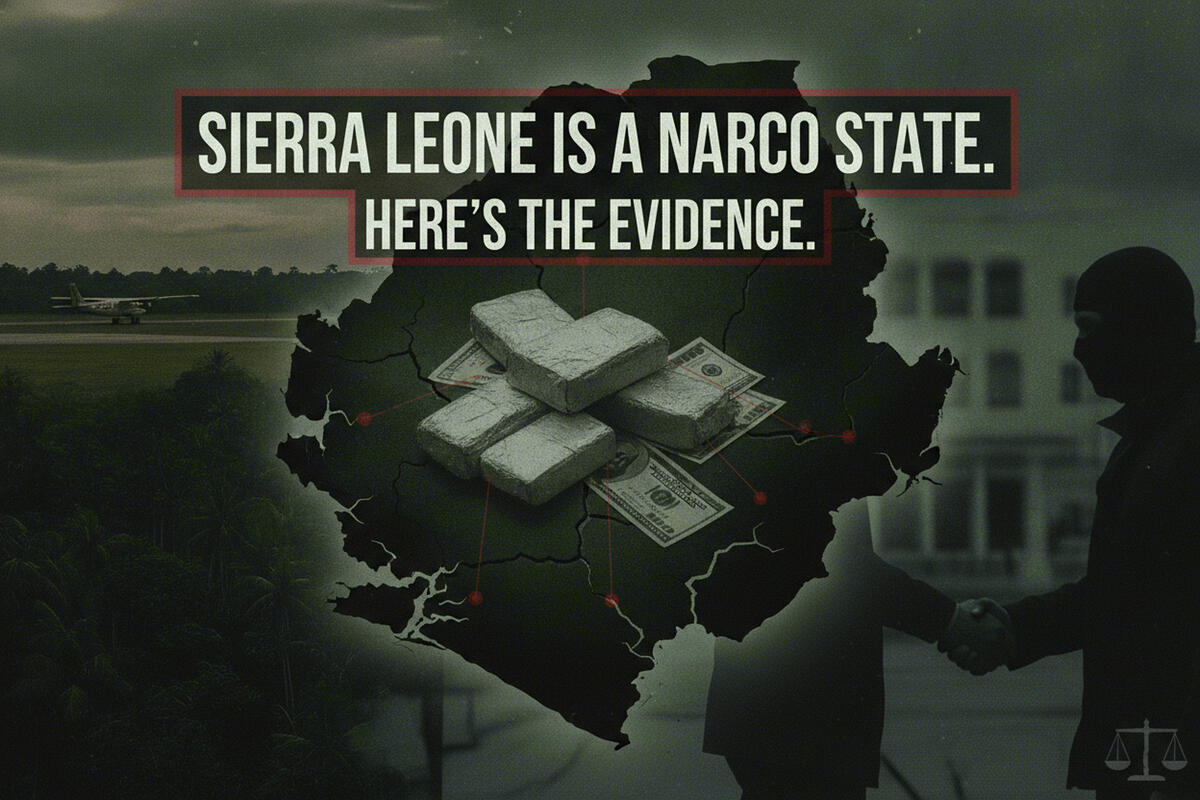
If you’ve typed “Sierra Leone narco state” into Google, you’re probably trying to work out whether it’s journalism or exaggeration. Short answer: on the evidence that’s now public, the label fits. Cocaine moves through the country in enormous volumes, people inside the state appear to shield the traffickers, and the government keeps declining to act when foreign governments hand it names and arrest requests. Some of that’s been proven in court. Some of it’s still allegation, and I’ll tell you which is which as we go, with a link to the source for every claim so you can check it yourself.
What Does “Narco State” Actually Mean?
Nobody agrees, which is the first thing worth knowing. A doctoral study at George Mason University opened by pointing out that there’s no standard definition of the term, and the argument over Guinea-Bissau, the country most often called Africa’s first narco state, still hasn’t settled. A Leiden University thesis concluded that Guinea-Bissau is better described as a weak state. A dissertation at ISCTE in Lisbon argued the label can apply under a looser definition, even though trafficking hasn’t swallowed the whole state.
So here’s the test I’m using, and you’re welcome to argue with it.
Three things:
Volume: the drugs move through in quantities that matter on a global scale.
Protection: people inside the state shield the trade, either by taking part or by looking away.
Impunity: when outsiders hand over names, evidence and arrest requests, nothing happens.
A transit country is a road. A narco state is a road with a toll booth, and the toll goes to someone in government.
The Ship That Left Freetown With More Than 30 Tonnes of Cocaine
On 1 May 2026, Spain’s Civil Guard stopped a cargo ship called the Arconian in international waters south of the Canary Islands. Officers found more than 30 tonnes of cocaine worth over $954 million and arrested 23 people. The Guardian’s investigation, syndicated on AOL, puts the load at between 30 and 45 tonnes, which would make it the biggest cocaine seizure ever recorded.
A Spanish court document, obtained by the Organized Crime and Corruption Reporting Project, says the ship set out from Freetown. In a second OCCRP report, a senior Civil Guard officer said he believes the cocaine was stored in Sierra Leone and organised by a Dutch fugitive called Jos Leijdekkers. Leijdekkers isn’t charged in the Spanish case, and his lawyer has denied he’s involved in large shipments from Sierra Leone.
Then there’s the Global Initiative Against Transnational Organized Crime, whose investigators concluded, according to reporting by NOS and NL Times in June 2026, that Leijdekkers and his network almost certainly coordinated the shipment. They cited witness statements, photographs and case studies of three ships, and found the evidence points to the cocaine being loaded in Sierra Leone. The ship waited offshore for speedboats to run smaller loads to land, with no seaport involved.
That detail matters. Thirty tonnes doesn’t assemble itself quietly. It needs storage, trucks, a berth, paperwork and a lot of people who don’t ask questions. The same Spanish officer told OCCRP that Leijdekkers appears to enjoy “total impunity, total confidence” in Sierra Leone, and that getting a cargo out of the country is easy for him.
Who Is Jos Leijdekkers, and Why Is He in Sierra Leone?
Start with what courts have decided. In June 2024 a Rotterdam court sentenced Leijdekkers in his absence to 24 years in prison for organising cocaine shipments and ordering a murder, and a Dutch court later confiscated $112 million from him. OCCRP reports that courts in the Netherlands and Belgium have sentenced him in absentia to more than 100 years in total. He’s on the EU’s most wanted list, and Europol calls him one of the key players in international cocaine trafficking.
Now what’s been reported. Two sources told Reuters in January 2025 that he’d been in Sierra Leone since at least early 2023, and Dutch prosecutors said he’d been there for at least six months. Verified video of a church service on 1 January 2025 shows him seated two rows behind President Julius Maada Bio. Three sources told Reuters the woman next to him was the president’s daughter, Agnes, and that she’s married to him. The footage came from a post on the first lady’s own Facebook page.
The government’s line is that the president attended many events over the festive period, posed for photographs with many people and had no knowledge of the individual in question. Nobody has produced evidence in court that the president took part in any trafficking, and it’s worth saying that plainly.
Then came the Guardian’s investigation in October 2026. Going by the syndicated version, it describes Leijdekkers as the president’s son in law and alleges he ordered killings in Freetown. A local summary of the piece notes that Yankuba Bio, who runs the port, denied any close relationship with him, and that the president’s office declined to comment while the investigation didn’t claim the president was personally involved in any crime. Treat all of it as allegation until a court rules.
For the long version of how a Dutch fugitive ended up so comfortable in Freetown, the New Lines Magazine reportage is the one I’d read first.
Why Hasn’t Sierra Leone Extradited Jos Leijdekkers?
This is the question I’d put at the centre of the whole thing, because it’s where “transit country” starts turning into something worse.
The Netherlands sent an extradition request in early 2025. There’s no extradition treaty between the two countries, so Sierra Leone isn’t obliged to hand him over, though it could do it voluntarily. Africa Confidential made that point at the time, and it’s a fair one. Sierra Leone’s information ministry also said at one stage that it couldn’t establish he’d entered the country under his real name. But the government has had well over a year to find another route, and as far as anyone’s shown, he’s still there.
In September 2026 the Dutch justice minister went on Sierra Leonean television to demand his extradition, and the chief minister accused him of neo colonialism. At the start of October, David van Weel said the EU had stopped €18 million in budget support to Sierra Leone for 2026 over the lack of cooperation, according to OCCRP’s report and Brussels Signal.
But the EU side tells it differently. The European Commissioner for Internal Affairs said the suspension was down to technical reasons, and Sierra Leone’s government said EU representatives had put it down to procedural issues, with payments now proposed for 2027 and 2028. A Dutch diplomat backed van Weel’s version. So that link is contested, and I wouldn’t build an argument on it. What isn’t contested is that the Dutch government is pushing hard, and that in September the European Parliament backed a new sanctions regime against trafficking networks by 601 votes to 4, without naming him.
Here’s my opinion, and I’ll own it. The chief minister has said the security services don’t know where Leijdekkers is. Reuters, Dutch prosecutors and the church service video say otherwise. A government that really wanted a convicted trafficker gone has plenty of ways to make that happen: an immigration order, a deportation, a quiet flight. Choosing to argue instead tells you something about who’s being protected.
What the Organised Crime Index Says About Sierra Leone’s Cocaine Trade
If you’d rather trust a database than a newspaper, the Organised Crime Index, run by ENACT with the Global Initiative Against Transnational Organized Crime and funded by the EU, is the one to read. Its 2025 profile scores Sierra Leone 7.5 out of 10 for the cocaine trade, up two points on the previous edition. It scores state embedded actors, meaning officials who take part in or protect crime, at 8 out of 10.
The text behind those numbers is blunt. It calls Sierra Leone a key logistics and redistribution hub for cocaine in West Africa, with shipments traced to Antwerp and Brussels, and says police corruption ranges from tip offs to serious collusion in trafficking. It also says criminal networks have infiltrated Freetown Port and Lungi airport, and that the cocaine trade enjoys serious political protection. The full 2025 ENACT report is free to download.
The detail that stuck with me is this one. ENACT reports no material cocaine seizures at Freetown Port in at least five years, even as large seizures linked to Sierra Leone keep turning up abroad. It reads that as a sign of political protection involving customs and senior figures.
Nobody seizes what nobody’s looking for. That’s my reading, not ENACT’s wording, but I can’t make the numbers say anything else.
A Container From Sierra Leone Lands in Felixstowe
Those seizures abroad aren’t abstract. In August 2022, UK officers found 1.3 tonnes of cocaine, worth £140 million, in a shipping container at Felixstowe. The National Crime Agency says it arrived from Sierra Leone, hidden in 20 kilogram sacks under a cover load of flour and meant for an industrial estate in Wigan. Nine suspects were arrested in November 2023.
I raise it for one reason. A British law enforcement agency, not an activist or an opposition politician, names Sierra Leone as the origin of a £140 million shipment. That’s the volume leg of the test, and it’s established.
The Embassy Car and Other Things That Aren’t Supposed to Happen
On 13 January 2025, Guinean authorities impounded a Sierra Leonean embassy vehicle in Conakry and detained its occupants. The foreign minister confirmed that seven suitcases of suspected cocaine and about $2,000 in cash were inside, according to BBC reporting carried by The Star. The ambassador wasn’t in the car and wasn’t arrested, but he was recalled to Freetown to explain.
Fact checkers at Dubawa deserve a mention here, because the story spread with wild exaggerations attached, including a claim of 380 kilograms and $100,000 and another that the ambassador was under house arrest. The foreign minister told them the real figures were far smaller. I mention it because the true version is bad enough without the embroidery.
One embassy vehicle proves nothing on its own. Put it next to the ship, the fugitive and the empty seizure records at the port, and it starts to look like a pattern.
Who Gets Caught in Sierra Leone, and Who Doesn’t
Small operators do get arrested. Court reports from Freetown show two foreign nationals committed to the High Court after being stopped at Lungi in September 2024 with 16 cocaine pellets, and a Nigerian man brought before a magistrate over 46 pellets. Awoko reported a 30 year sentence for a Nigerian national over 900 grams.
Set that against the tonnes that leave by ship, and the one fugitive nobody can find. Couriers go to prison. The cargo leaves on a vessel.
How Sierra Leone Handled Cocaine in 2008
It wasn’t always like this, or at least it didn’t look like it. In July 2008, a small plane painted with Red Cross markings landed at Lungi in the dark without permission, carrying roughly 700 kilograms of cocaine. The National reported that six agencies were involved and dozens of suspects were arrested. According to a Sierra Leonean case study, eighteen people were charged at home and the country rushed through the National Drugs Control Act. Two men were sent to New York to face charges, per a US Drug Enforcement Administration press release, and police burned the haul in April 2009.
I wouldn’t rose tint it. People close to the investigation said at the time that landing at Lungi so openly pointed to complicity somewhere high up, and the case study lists official involvement as one of the main obstacles. But the state did arrest people, hand some over and pass a law.
Compare that with 2026, when a ship carrying a mountain of cocaine reached the open sea from Freetown and the most wanted man in the story is still living in the country. Same state. Very different behaviour.
What the Government and the Accused Actually Say
Fair is fair, so here’s their side. The government denies protecting Leijdekkers and says the president had no knowledge of him. It said in early 2025 that police were hunting for him. In February 2026 it announced 52 convictions linked to drug trafficking and organised crime, which it described as a serious threat to national security, as OCCRP noted. After the Arconian bust, Africanews reported that authorities were investigating the circumstances.
Yankuba Bio has called the claims about the port false and without foundation. Leijdekkers’ lawyer has denied his involvement in large shipments. And the Guardian, as summarised above, doesn’t allege the president was personally involved.
Those denials matter. Fifty two convictions also matter, though ENACT says no traffickers were convicted for human trafficking in 2023 or 2024, and nothing I found shows a prosecution reaching the top of the cocaine trade.
The opposition isn’t buying it. Abdul Kargbo, who leads the All People’s Congress, wrote an open letter to the president in May 2026 criticising the government’s silence and hesitation, and warning that the case fed suspicions of political protection.
What Happens to People Who Ask Questions
One more thing about impunity. Follow the Money reported that Sierra Leonean journalists have faced reprisals and pressure over coverage of Leijdekkers, while the government’s refusal to pursue him has fuelled suspicion of high level corruption. ENACT’s profile also says journalists in the country face violence, harassment and difficulty getting information, especially around elections.
I can’t prove a link between the two, and I won’t pretend to. But if the story were only about a visitor hiding quietly, you’d expect fewer people to be nervous about writing it.
Is Sierra Leone Really a Narco State, or Just a Weak State With a Cocaine Problem?
Actually, let me be straight about the counter argument, because it’s strong. In the strictest sense, a narco state is one where drug money has captured the economy and the government, as happened in parts of Latin America. Sierra Leone’s economy still runs mostly on mining, farming and aid, and cocaine hasn’t replaced any of that.
Weak states and narco states also look alike from the outside. Underpaid police, porous coastlines and a thin navy will produce a transit hub without anyone in power planning it. ENACT’s resilience score for Sierra Leone is 4.04 out of 10, which is weak, and it describes limited resources as well as corruption.
So why do I still say the label fits? Because the Guinea-Bissau debate gave us the answer. The ISCTE study I mentioned concluded the label can apply when the trade shapes how top officials compete for power and govern, even if it hasn’t taken over everything. By that standard, and by the three part test above, Sierra Leone qualifies: the volume is documented by the National Crime Agency and Spanish investigators, the protection is described by ENACT and alleged by serious reporters, and the impunity is on the record every time an extradition request goes unanswered.
You might prefer “state capture”, which is the term several reports use. I think the difference matters more to academics than to a Sierra Leonean watching the money move.
Kush: Where the Drug Trade Reaches Ordinary Families
Cocaine is the export business. Kush is what the rest of the country lives with. It’s a cheap synthetic drug that has spread across Freetown since 2021, and ENACT says it contains synthetic cannabinoids or nitazenes, which are powerful synthetic opioids. The chemicals are imported from places like China, the Netherlands and the UK, but making the final product increasingly happens inside Sierra Leone.
In April 2024 President Bio declared a national emergency over it and set up a national taskforce, which ENACT calls an unprecedented step. The drug has also spilled across borders, and Liberia has blamed its neighbours for fuelling its own crisis.
That one deserves a second look. The state can declare an emergency over kush. I haven’t seen an equivalent one over cocaine.
Does Any of This Affect You If You’re Visiting or Doing Business in Sierra Leone?
For most visitors, day to day, not directly. The cocaine economy runs through ports, boats and well connected people, not through the guesthouse or the beach. I wouldn’t tell anyone to cancel a trip over it, but check the Foreign, Commonwealth and Development Office travel advice for Sierra Leone before you book, because it changes.
The part that does touch you is corruption. ENACT says bribes are common even at official border posts, and that starting a business is heavily shaped by political connections. If you’re investing, due diligence on partners isn’t optional, and neither is knowing who owns a company.
And one rule that applies everywhere in the region, but especially around Lungi. Never carry anything across a border for anyone, however friendly they seem and however small it looks. The couriers in those court reports didn’t think they were taking a risk either.
Where to Check All of This Yourself
Please don’t take my word for any of it. For the numbers, start with the Organised Crime Index profile. For the ship, read OCCRP’s court file report and the Global Initiative findings relayed by NL Times. For the UK case, the National Crime Agency’s own release is short and clear.
For the political side, Africa Confidential’s special report, Reuters’ original reporting and the Follow the Money investigation are the strongest. And for the other side, the government’s own statement is worth reading in full.
One Last Thing
I know this isn’t the easy version of the story. Sierra Leone has a lot going for it: the coastline, the music, the people who’ll feed you before they’ve asked your name. None of that gets cancelled out by what you just read.
But a country is bigger than its government, and most of the people hurt by this trade are Sierra Leoneans. The families dealing with kush, the police officers who aren’t on anyone’s payroll and the journalists who’ve been threatened for asking questions all carry the cost. They’d probably tell you the same thing I would: the word you use matters less than whether somebody finally acts.


