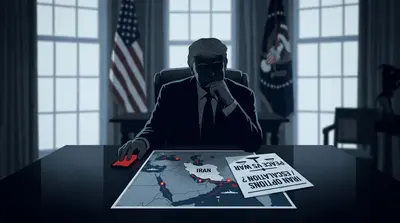


The recent Republican defeat in the US midterm elections has made the conflict in Iran a political burden for Donald Trump. Voters are increasingly dissatisfied with the war and its economic costs, placing pressure on the president to seek an exit strategy. However, after meeting his national security team on 5 November, Trump announced he would decide “soon” whether to escalate military actions. This situation highlights a contradiction: while the war has weakened Trump politically, it hasn’t curtailed his ability to expand it.
With the Democrats now controlling both chambers of Congress, scrutiny over the administration’s handling of the war will likely increase, giving the opposition leverage over funding. Nonetheless, the new Congress won’t take office until January, leaving Trump significant authority over military operations in the meantime. A chastened president might opt for diplomatic restraint or, conversely, may choose to assert authority through military action before Congress can respond.
Political repercussions are already apparent. Vice-President JD Vance has partly attributed the Republican loss to the war. He also wrote a letter to Iran’s national security chief, Mohsen Rezaei, calling for renewed negotiations while insisting that Iran’s nuclear programme be addressed. Trump, however, claimed the letter was focused on humanitarian aid, attempting to deflect political ramifications from the diplomatic efforts. Senior officials within the administration are divided; Defence Secretary Pete Hegseth and Israeli PM Benjamin Netanyahu advocate for a tougher military stance, while envoy Steve Witkoff supports pursuing a diplomatic agreement.
Netanyahu’s political position has weakened following Israel’s elections, but he remains prime minister with influence over security decisions, continuing to push for action against Iran. The US Central Command is preparing for a potential return to major military operations, although no new order has been issued yet. Aides have suggested strikes could occur soon after the midterms, with concerns raised about a nuclear strike against the Iranian Natanz facility. US Senator Chris Murphy called the military plans “insane,” warning they could escalate the conflict further, jeopardising security interests.
Recent history suggests caution; a June agreement mediated by Pakistan and Qatar aimed at easing tensions quickly fell apart. Any future agreement must navigate prevailing distrust between the parties involved.
Meanwhile, diplomatic efforts persist. Qatar is mediating between Washington and Tehran, seeking to re-establish direct negotiations through a series of confidence-building measures. Despite a lack of official breakthroughs, Qatar’s Emir recently spoke with Trump to discuss the situation. Iran’s Foreign Minister has held discussions with mediators from multiple countries, signalling continued engagement on both sides.
Iran is pushing for the end of US sanctions, the release of frozen assets, and the reopening of the Strait of Hormuz, while Washington demands assurances against Iran rebuilding its nuclear programme. The disagreement stems partly from the order in which concessions would be made, with both sides unwilling to budge without guarantees.
Gulf nations face significant risks beyond these negotiations; their energy infrastructure and civilian populations are vulnerable to renewed hostilities. Qatar’s Emir has stressed the need for preparedness while announcing plans for a domestic defence production hub focused on missile defence and cybersecurity.
In addition, Saudi Arabia, Pakistan, and Türkiye are strengthening security cooperation through the Makkah Joint Defence Agreement, which includes provisions for mutual defence and intelligence sharing. This agreement has gained urgency following recent missile attacks on Saudi airports.
On 26 October, senior officials from these countries met with Iranian President Masoud Pezeshkian in an effort to defuse tensions. New military cooperation agreements have also been established, indicating a regional shift towards self-defence capabilities, acknowledging the risks of prolonged confrontation with Iran.
The geography of the region adds urgency to these efforts. The Bab el-Mandeb strait also presents vulnerabilities, with Houthi attacks disrupting Red Sea shipping and significantly affecting Egypt’s Suez Canal revenues. If hostilities escalate further, the consequences could extend globally, affecting energy exports and supply chains.
Moreover, the undersea fibre-optic cables critical for international communications could also be targeted. A past incident highlighted vulnerabilities when a Houthi attack led to widespread disruption of communications for months.
Recognising these risks, Iran’s messaging has adapted, including civilian guidance on responding to potential nuclear attacks, reflecting the growing anxiety about possible escalation.
The Gulf states are preparing for potential conflict, not relying solely on diplomatic solutions. They are enhancing their defence capabilities while pursuing mediation efforts. As Washington faces critical decisions, the ramifications of renewed conflict could reverberate beyond just the immediate region, deepening an economic crisis felt globally.
The midterm elections have made the war politically costly for Trump, but have not diminished the risks of conflict. The pressing question remains whether this electoral message will push for a diplomatic resolution or further escalation, which the Gulf nations are already preparing to manage.