


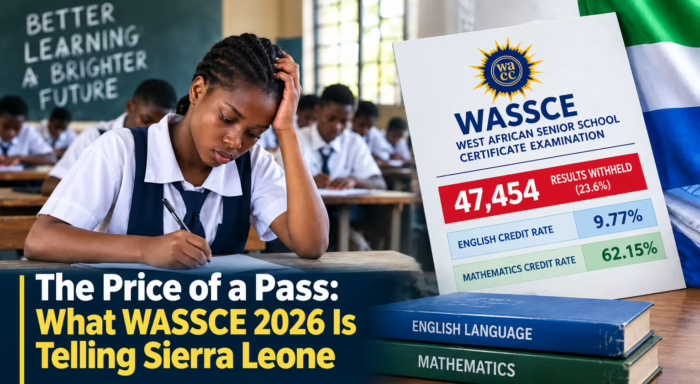
Sierra Leone’s 2026 WASSCE results reveal a troubling trend despite a seeming increase in passed candidates. While more students passed than last year, one in four had their results withheld due to suspected malpractice, and fewer than ten percent achieved a credit in English. This suggests a system more focused on passing than genuine learning.
On 27 October, the Minister of Basic and Senior Secondary Education, Conrad Sackey, announced that of 200,756 candidates, 141,810 received results while 47,454 had theirs withheld. For many families in communities from Kroo Bay to Kailahun, the stark word “withheld” appeared on their screens.
Having both sat and taught this examination extensively, I see these figures not just as a setback but as a signal that we risk prioritising passing above true education. Many honest students face consequences due to others’ dishonesty.
Reflecting on my time at St Edward’s, where we prepared for WASSCE in competitive study groups across Freetown, I commend the strong performance of current candidates from schools like St Edward’s, Awada in Bo, and Sierra Leone Grammar School. Their achievements indicate that excellence is still attainable.
However, today’s students increasingly invest in questionable “materials” before exams rather than dedicating time to study. The trend is concerning, especially with a surge in withheld results that rose to 23.6%, the highest in four years.
Regionally, Nigeria withheld 167,486 results, approximately 8.6% of its candidates, while Ghana cancelled 8,295 results. The Ministry of Education attributes the rise in Sierra Leone to better detection of malpractice, but the prevalence of cheating raises alarms about the integrity of our examinations.
There are 47,454 candidates waiting for their results, deserving both an urgent and fair review process. Delays in addressing their withheld results can have far-reaching impacts, including lost university placements and a potential drop in student numbers, especially among young women.
The disparities in subject performance are stark. In 2026, the Mathematics credit rate soared to 62.15%, while English saw a decline to 9.77%. Such discrepancies warrant scrutiny, raising questions about English teaching effectiveness and the means by which answers are obtained during examinations.
The decline in English credits itself, despite previous efforts to improve, signals a deeper issue within the educational framework. Although more students are now eligible for WASSCE, underlying conditions for effective learning remain unmet.
To tackle these challenges, measures must be implemented that prioritise integrity within examination halls while ensuring every candidate receives a fair chance. This includes strict enforcement against malpractice and enhancing the quality of English teaching across schools, as well as addressing the need for more qualified educators.
Finally, Sierra Leone must view this situation as a national emergency. A collective effort is required—bringing parents, teachers, past students, and the government together to discuss a path forward. If we continue down this road of mediocrity in education, the future of our youth and our nation is at stake.
Dr Mohamed Ibrahim Justice Ganawah is a Senior Lecturer in Economics at Fourah Bay College and Founder of Ganawah’s Insight Corner. He writes in a personal capacity.


