


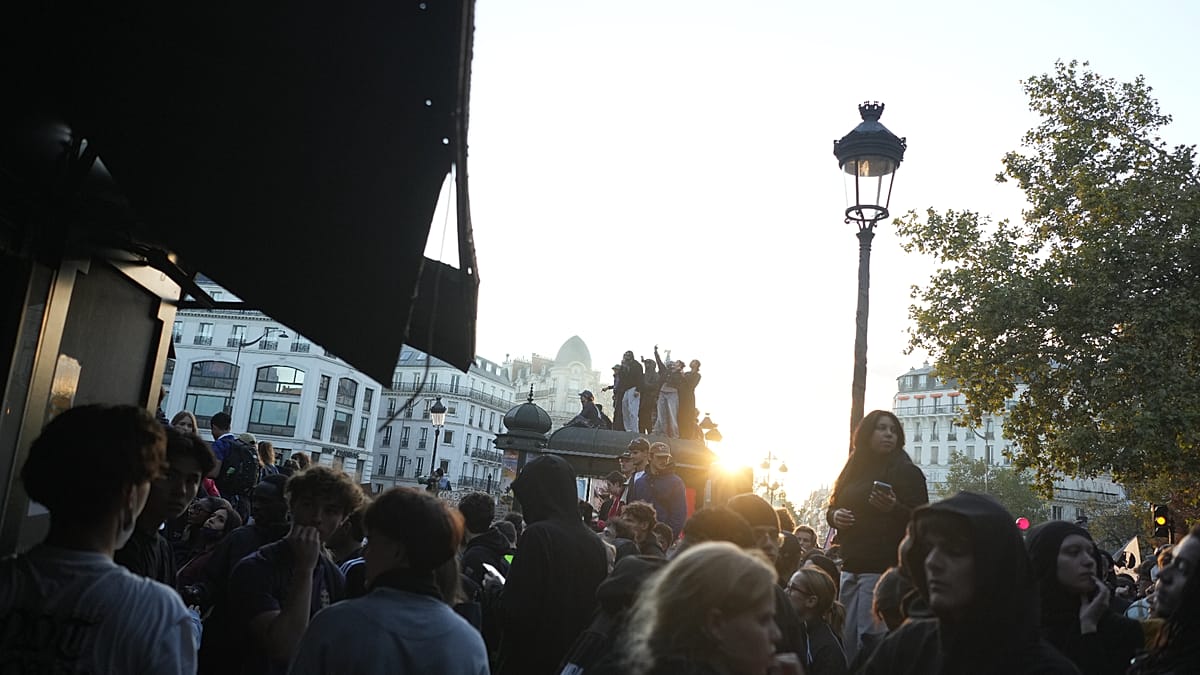
Thousands across Europe protested over the weekend against rising living costs, unaffordable housing, low wages, and strain on public services. Although specific grievances varied by country, the demonstrations underscored widespread frustration with household budgets.
In France, hundreds of thousands participated in demonstrations, including students protesting over living costs and public services. While most marches were peaceful, some descended into chaos, prompting President Emmanuel Macron to promise to hold accountable those who “sought to bring down the Republic.” Notable incidents included fires at Limoges city hall and a tourist office in Lyon, as well as vandalism at town halls in Marseille, Lille, and Angers, and an attack on the prefect’s residence in Bordeaux. Limoges Mayor Guillaume Guérin condemned the violence as “unacceptable,” asserting that while anger should be heard, it does not justify destruction of public property.
Belgium saw clashes between police and demonstrators in Brussels and Liège during similar protests. High-school students had also recently rallied against rising education costs, echoing sentiments from their French counterparts facing teacher shortages. Belgian Interior Minister Bernard Quintin described the turmoil as “pure and simple violence,” aligning with Limoges’ mayor’s views.
In Portugal, trade unions and housing-rights groups demanded higher wages, better pensions, and improved public services, citing soaring rents and mortgage costs as heavy burdens. Italy was not far behind, with protests erupting over economic conditions. Reports indicated clashes in Milan, Turin, and Bologna, resulting in injuries and multiple arrests.
The anger across Europe stems from rising food, housing, and energy costs, making it increasingly difficult for many households to stretch their incomes. Even as inflation eases, prices remain elevated, limiting consumer budgets. Renters and younger adults are particularly affected, with essential expenses putting pressure on low-paid workers and further fuelling dissatisfaction with education and public services in certain regions.
Eurostat data shows food and non-alcoholic beverage prices in the EU surged by 34% from August 2021 to August 2026. In Malta, Spain, and France, the amount of food accessible with a gross monthly minimum wage fell by 6%, 5%, and 4%, respectively, highlighting the growing cost-of-living crisis.
While the protests are not a unified Europe-wide movement and their demands differ, they reflect mounting pressure on household finances and the challenge of keeping wages in line with the rising cost of essentials.


