


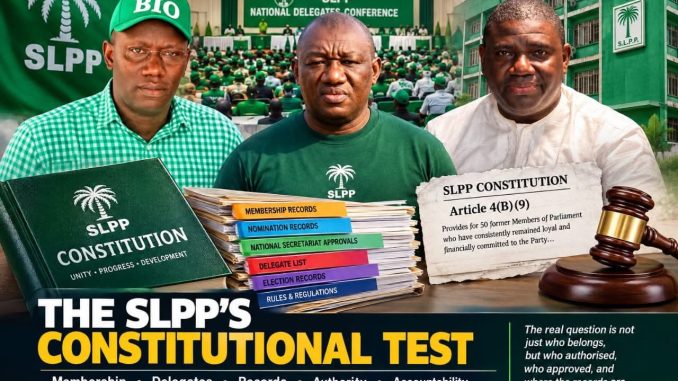
The SLPP’s Constitutional Challenge
A disagreement regarding Musa Tarawally’s membership within the Sierra Leone People’s Party (SLPP) has raised pressing questions about the legitimacy of his participation in the National Delegates Conference. If he was not constitutionally qualified to vote, how was he allowed to contribute to the election of the Party’s current leadership? This matter extends beyond Tarawally, calling into question the decisions and records that permitted his involvement.
The SLPP Constitution designates the National Delegates Conference as the Party’s top governing body, which oversees its strategic direction. Article 4(B)(9) allows for up to 50 former MPs, who have shown unwavering loyalty and financial support for the Party, to be nominated and approved by the National Secretariat. Tarawally, formerly an SLPP MP, was listed among the delegates who participated in the Conference. The core issue now lies in understanding the constitutional basis for his inclusion, nomination, and approval.
Under Article 4, the Conference is tasked with electing National Officers every three years through a secret ballot. The National Executive Committee (NEC) is responsible for overseeing the Party’s activities and appointing an elections management team. This creates a comprehensive framework tying delegate selection, election management, and officer appointment together.
The sequence of events is crucial. Tarawally did not merely assert his status post-event; he actively participated as a delegate. The question remains whether Party records confirm that his status was validated according to Article 4(B)(9) and, if so, by whom. The National Secretariat plays a key role in documenting Party records, which should detail membership, nominations, approvals, delegate lists, and election documentation.
Article 2 of the Constitution outlines membership criteria, stating that a member ceases to belong to the Party when they notify the National Secretary-General or by joining another party. If Tarawally was unqualified to serve as a delegate, it raises concerns about the previous Executive’s conduct during the Conference that elected the current members. Were his credentials recognised and accepted according to Party rules, and if the current Executive questions them, what did the previous Executive know?
Recent correspondence from September 2026 complicates matters further. National Chairman Batilo Songa claimed that the SLPP sought confirmation of Tarawally’s membership from the Citizens Democratic Party (CDP) and received a response stating he remained a member there. Tarawally disputes this and contends he left the CDP in 2018. The constitutional inquiry, however, must focus on which Party body initiated the investigation, under what authority, and how the findings were utilized.
The Constitution outlines clear administrative structures. Article 6 lists National Officers, while Article 7 clarifies the management roles. The pertinent question is not whether any office lacks authority but rather identifying the specific constitutional basis for the actions taken.
This authority also pertains to the public notice issued by the National Publicity Secretary, which must comply with the Party’s communication rules. Likewise, the formal disciplinary procedures set out in Articles 19 and 20 require clarity on which constitutional provisions were leveraged in any decision-making process.
Additionally, the wider legal context underscores the necessity for proper procedural adherence without resolving Tarawally’s membership dispute. Article 23 of the SLPP Constitution acknowledges the relevance of State laws aligning with the Party Constitution, reinforcing democratic principles outlined in Sierra Leone’s Constitution.
The existing records affirm the institutional framework: the Constitution defines the criteria for delegate eligibility, mandates the National Secretariat’s role in approvals, and assigns the NEC responsibilities in election oversight. However, it remains unclear whether all requirements were met concerning Tarawally’s situation and what authority supported inquiries into his membership.
These unresolved issues should be clarified through constitutional provisions and Party documentation, rather than through political arguments. If the records uphold the Party’s stance, it can assert its position authoritatively. Conversely, any inconsistencies warrant scrutiny, as they relate to the very framework that governed the Conference which established the present leadership.
Ultimately, the strength of an institution lies not just in declaring membership but in being transparent about the documentation and decisions that uphold its governance.


