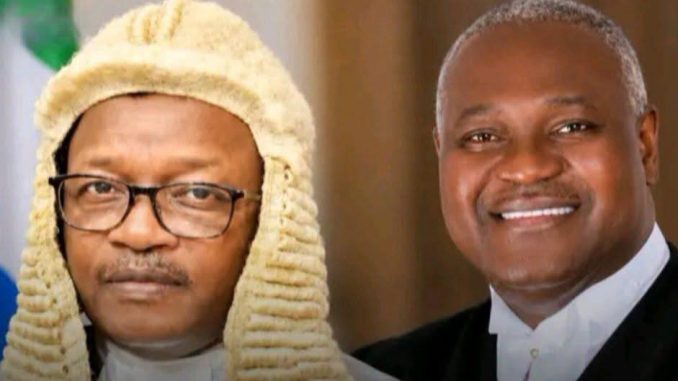
A significant political confrontation took place in Freetown on Tuesday between the Supreme Court and Joseph Fitzgerald Kamara, the lead attorney for the opposition All People’s Congress (APC), during discussions about the contentious 2025 Constitutional Amendment Bill.
Tensions flared as Chief Justice Komba Kamanda and Kamara clashed over preliminary objections raised by the APC legal team concerning the Bill’s passage in Parliament. After a heated exchange, the Chief Justice dismissed Kamara’s objections regarding procedural issues and filed technicalities related to Rule 92.
Following this ruling, the court adjourned to consider applications to consolidate various related constitutional cases linked to the Bill. This legal challenge revolves around the manner in which the Bill, affecting presidential election thresholds and proportional representation, was passed. President Julius Maada Bio referred the matter to the Supreme Court under Section 122(1) of the 1991 Constitution instead of signing it, amid parallel lawsuits filed by the APC and several MPs.
Kamara’s procedural objections aimed to challenge whether the Attorney-General’s application to consolidate the cases met necessary preliminary requirements under Supreme Court Rules. During the hearing, Justice Kamanda pressed him on the legal basis for his objections.
The Supreme Court has yet to rule on the main constitutional issues surrounding Sections 91 and 108. Discussions will continue on 8 October 2026 regarding the consolidation of the cases.
In another key development, the absence of the Speaker of Parliament, Rt. Hon. Segepoh Solomon Thomas, during the proceedings led to public speculation. His lawyer attributed the absence to illness, while Parliament later clarified he was on official duty. This contradiction raised questions about communication and transparency in a politically charged environment.
The Supreme Court also allowed the Institute for Legal Research and Advocacy for Justice (ILRAJ) to act as amicus curiae, to provide independent legal insight into the proceedings.
As the first day concluded, Sierra Leoneans were left awaiting answers to vital constitutional questions, showing that such disputes are deeply intertwined with issues of institutional credibility and public confidence.