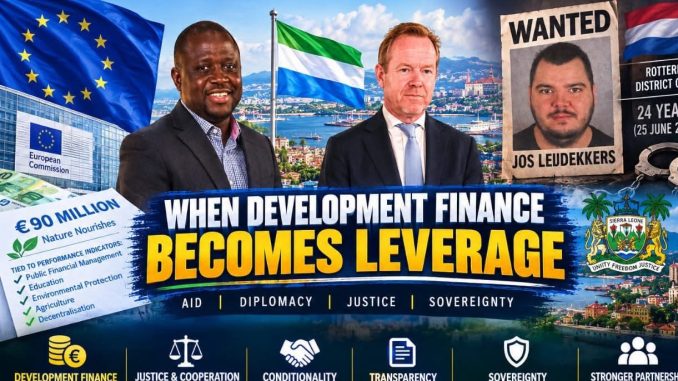
The European Union’s decision to withhold budget support for Sierra Leone in 2026 has taken on significant implications. Dutch Justice and Security Minister David van Weel noted that the measure aims to pressure Freetown into arresting and extraditing Jos Leijdekkers, a fugitive Dutch drug trafficker. However, Sierra Leone maintains that the EU’s decision, made in July, was unrelated to Leijdekkers and stemmed from the late request to amend its financing agreement.
The case against Leijdekkers is serious; the Rotterdam District Court sentenced him to 24 years in June 2024 for transporting over 7,000 kilograms of cocaine, committing a violent robbery in Finland, and soliciting a murder. Dutch authorities have expressed a strong interest in extraditing him from Sierra Leone, but it’s contentious to tie Sierra Leone’s development financing to this individual case.
The financing agreement highlights this distinction. The EU’s €90 million Nature Nourishes programme includes up to €65 million in budget support over four years, tied to improvements in public financial management, education, environmental protection, agriculture, and decentralisation. In December 2024, the EU approved the first €11 million payment, which directly supports Sierra Leone’s Treasury.
The timeline is crucial. Sierra Leone asserts that the EU’s 2026 decision was communicated in July, citing the late request for amendments and the challenges of completing necessary procedures. Reports indicate conflicting reasons: Van Weel claimed the suspension aimed to exert pressure regarding Leijdekkers, while EU Commissioner Magnus Brunner attributed it to “technical reasons.” Until the EU publishes its decision, the connection remains unclear.
This conditionality may pose challenges. While the EU has the right to ensure that public funds are spent appropriately, linking development finance to a specific criminal case muddies the waters. This separation is essential to maintain stable partnerships and avoid retrospective changes to agreements.
The fiscal impact is significant. The International Monetary Fund’s 2026 review indicated that Sierra Leone’s budget parameters are being adjusted due to delays in budget support. Additionally, the government has pledged to repay overdue loans to the Bank of Sierra Leone, equating to approximately 1.5% of GDP, by the end of 2026. However, the IMF evidence does not directly connect these financial issues to Leijdekkers.
The Dutch interest in Leijdekkers extends beyond one individual. The Dutch Public Prosecution Service has pursued over €221.6 million in assets connected to drug trafficking cases. This underlines the importance of international cooperation, although it does not clarify the legitimacy of the financing conditions.
Sierra Leone claims commitment to tackling transnational crime and judicial cooperation, provided it respects national laws and procedures. Their credibility hinges on proving that they follow the law, rather than responding to external pressures.
The EU, too, has obligations. Its partnership with Sierra Leone encompasses democracy, rule of law, and development, marking fifty years of cooperation. If the July financing decision was purely administrative, this should be clarified, just as any political motivations should be precisely stated. The foundation of this relationship should avoid ambiguity regarding financial objectives.
This lesson extends to donor and recipient states alike. Donor countries increasingly expect development aid to address security issues without undermining legal processes in recipient nations. Both sides’ interests can be valid, but they require clear, separate channels. If development financing becomes indistinguishable from coercive diplomacy, future agreements will be harder to interpret and public trust will decline. True partnerships are characterised by cooperation within a clear framework of rules.
Transparency is essential in resolving this immediate dispute. The Netherlands must pursue its legal interests through lawful means. Sierra Leone needs to demonstrate that it can respond to international requests without compromising due process. Meanwhile, the EU should articulate the legal reasoning behind any changes to its financing agreements. Ultimately, the credibility of all parties will be judged not by current pressures but by their ability to maintain integrity and trust once the controversy subsides.