





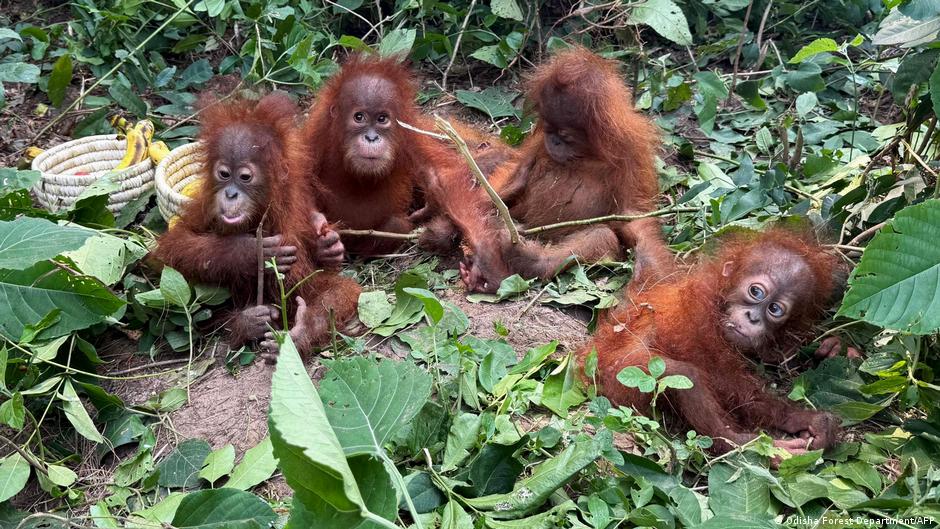
Five infant orangutans, a species native to the Indonesian islands of Sumatra and Borneo, were discovered last week in a forest in the Balasore district of Odisha, India, by forest rangers.
Indonesia’s Forestry Ministry has requested that India ascertain the origin of the abandoned orangutans, known for their distinctive red fur, and return them if they are confirmed to have come from their natural habitat.
The rescue has sparked concerns over how exotic animals enter India and the country’s role in the illegal wildlife trade.
“This discovery on India’s eastern coast is astonishing,” said Kanitha Krishnasamy of wildlife trade monitoring network TRAFFIC. “What are orangutans doing in India? Were they smuggled from Malaysia or Indonesia, or did they originate from a facility?”
The Odisha government has called on the Wildlife Crime Control Bureau to investigate the arrival of these critically endangered animals. “These animals do not belong in India; they are primarily found in the rainforests of Southeast Asia,” stated Ganesh Ram Singh Khuntia, Odisha’s Forest and Environment Minister. He expressed suspicion that the orangutans might have been released in Balasore by an international wildlife smuggling ring.
The discovery is part of a concerning trend, with increasing seizures of exotic wildlife in India. In November 2024, for example, Bengaluru authorities seized 40 rare animals arriving from Kuala Lumpur, Malaysia, including Aldabra giant tortoises and gibbons. Further, in June 2025, Mumbai Customs confiscated 284 exotic animals from four different consignments coming from Bangkok, Thailand.
Recent statistics from TRAFFIC revealed that between January 2022 and May 2025, 7,272 animals—both alive and deceased—were seized from passenger baggage in smuggling attempts between Thailand and India, with over 80% of interceptions occurring in India.
“Hundreds of species and thousands of individuals are trafficked into India via various routes,” noted conservation researcher Uttara Mendiratta. She pointed out that both the volume of trafficking and the number of involved species, many of which are endangered, have surged since 2020.
Trishala Ashok, a conservation filmmaker, highlighted that law enforcement has not kept pace with the rising illegal trade. She remarked, “Our enforcement systems haven’t evolved as quickly as the trade. We’re still responding to individual seizures rather than dismantling the networks behind them.”
Tito Joseph from the Wildlife Protection Society of India stated that smuggling has increased significantly since 2018, with routes identified from Myanmar and Bangladesh into India.
The demand for exotic pets is exacerbated by social media, facilitating the growth of the illegal trade. “These platforms serve as an online marketplace for the illegal trade to flourish,” said wildlife biologist Ravi Chellam.
Establishing the origin of trafficked animals becomes increasingly complex as they cross multiple borders. “A seizure should not be the end of the investigation; it should be the beginning,” Ashok added, emphasising the need to trace trafficking networks more effectively.


