


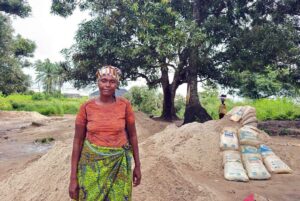
Sand Mining at Mahera Beach Threatens Ecology and Livelihoods
Sand mining at Mahera Beach in Sierra Leone is harming local tourism and coastal ecosystems while altering the landscape. Each year, nearly 50,000 cubic metres of sand are extracted from the beach, leaving communities caught between earning a livelihood and preserving their environment. Women make up a significant part of the workforce in the sand value chain, often facing economic and social challenges.
In the agricultural area of Mahera, about 27 kilometres from Freetown, young men dig sand during low tide, filling cement bags to sell. Local women then buy this sand to sell it to truck drivers for transport to Lungi and other locations. The earnings help families cover food and educational expenses, but their work is heavily reliant on tide cycles—sand can only be purchased during low tide.
Initially a survival tactic for 14 women, the sand trade has evolved into a vital income source for many, with a recent World Bank report highlighting the environmental and economic impacts of sand mining on coastal communities.
Aminata Kargbo, chairperson of the local sand sellers, entered the business to support her seven children after her husband passed away. “We lost our husbands, and the money we earn goes to support our children,” Kargbo said, overseeing a group of mostly widowed sand sellers.
The sand trade has created a small supply chain that includes young male shovelers, women buyers, landowners providing storage, and truck drivers. However, as casual mining erodes coastlines and impacts tourism, women bear the brunt of physical labour and the economic burden caused by weak employment opportunities.
Globally, the demand for sand is high, making it a crucial yet damaging resource. A U.N. Environment Programme study warns of the risks associated with increased extraction, causing significant biodiversity loss and climate change threats.
In Mahera, local leaders advocate for clear mining areas to protect fishing zones. Pa Morlai Kargbo, senior headman of Mahera, noted that what was once a popular beach for recreational outings is now primarily a mining site.
The World Bank report identifies local construction as the primary driver of demand for sand in Sierra Leone, with significant implications for the livelihoods of shovelers, sellers, and truck drivers. Despite existing laws regulating sand mining, enforcement is weak, drawing concerns from residents about potential restrictions that could threaten their incomes.
Many residents, including Kargbo, are open to transitioning away from sand mining but stress the need for viable economic alternatives before any restrictions are imposed. Young sand miners like Abdulai Conteh, who previously worked as a tailor, stress how the income is vital, with fears that banning the trade would lead to increased crime due to a lack of work options.
Experts urge a gradual transition away from sand mining in favour of supporting alternative livelihoods like tourism and fisheries. Abu-Bakar Massaquoi, executive chairman of the Environmental Protection Agency, acknowledges the need for better regulation and community involvement in balancing environmental protection with the economic needs of those dependent on the sand trade.


