




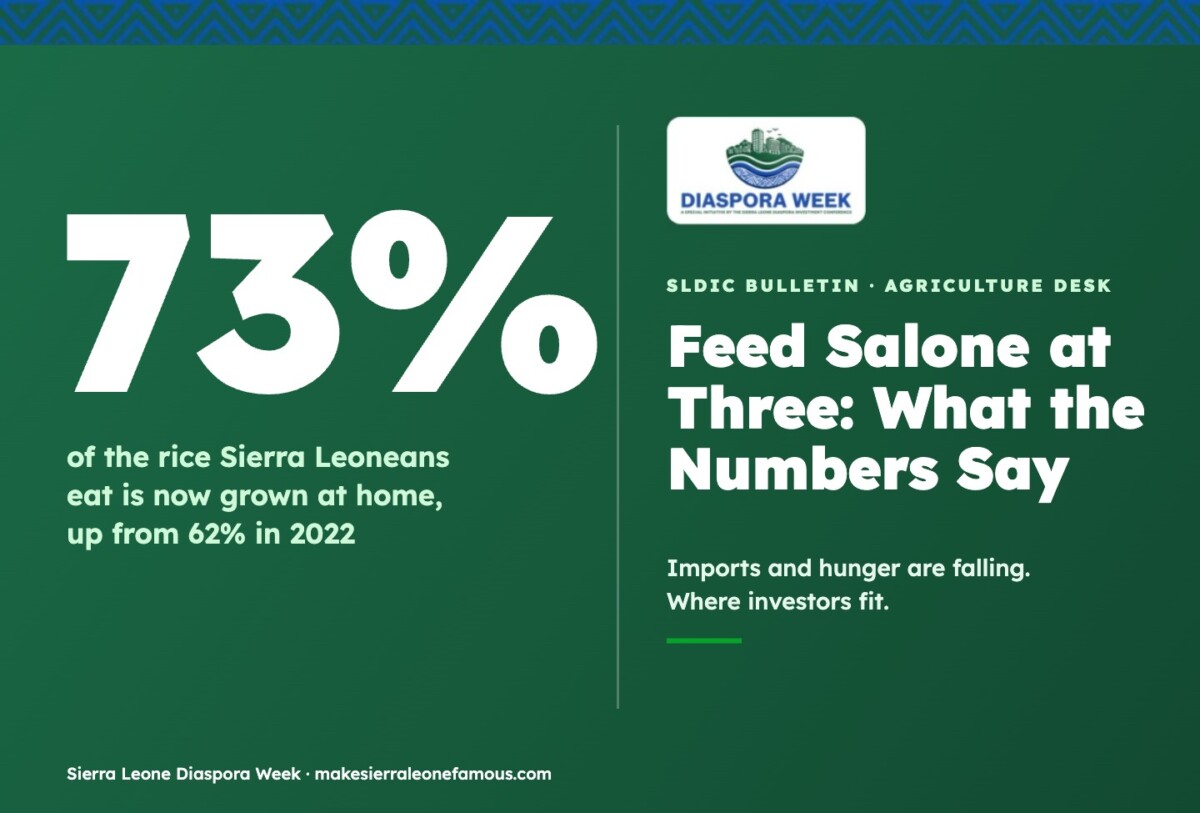
Sierra Leone is making strides in food self-sufficiency as its Feed Salone initiative marks three years of progress. The country is now producing more of its own rice, significantly reducing imports of eggs and onions, and decreasing the number of families facing hunger. However, many large projects are delayed, and a substantial portion of pledged funding has yet to materialise.
This information comes from the Feed Salone Year Three Report, released by the Ministry of Agriculture and Food Security under Minister Dr Henry Musa Kpaka, covering the period from October 2025 to September 2026. The report notes that ongoing conflicts in the Middle East have driven up fuel and fertiliser costs.
Here are some key statistics from the report:
- 73% of the rice consumed in Sierra Leone is now domestically produced, up from 62% in 2022.
- 13% of households are severely food insecure, a significant drop from 28% in September 2023, though the goal is to reduce this to 10%.
- 22,708 jobs have been created, with women holding 48% of these positions and youth making up 71%.
- Over 8% of the national budget is now allocated to agriculture, an increase from just 2% prior to Feed Salone.
- More than US$1 billion has been pledged, with 43% currently in active projects, up from 27% a year ago.
In rice production, the import bill has decreased from approximately US$177 million to US$154 million. Rice cultivation has expanded to cover 661,016 hectares, with average yields improving from 2.13 to 2.37 tonnes per hectare.
Inland valley swamps play a crucial role, producing 58% of the rice from less than half of the total rice area. The area of rehabilitated swamp land increased from 1,950 hectares in 2023 to 6,615 hectares in 2025. New rice milling facilities in Tormabum and Gbondapi, each capable of processing about 8 tonnes of rice per hour, are expected to open in early 2027.
Sierra Leone has achieved significant progress in reducing imports of eggs and onions:
- Egg imports plummeted from roughly 56 million in 2024 to around 31 million in 2025, a decline of over 40%. Local poultry farms now produce approximately 475,000 eggs daily. A 35% tariff on imported eggs began in January 2026.
- Onion imports fell by 82%, from 12,145 tonnes in 2024 to 2,195 tonnes in 2025. The price of onions dropped to approximately NLe 34 per kilo, down from NLe 50 or more in earlier 2024.
While cash crops such as cocoa and cashew have seen fluctuations, their exports raise concerns for local farmers. Coffee exports, for example, varied dramatically from 2,908 tonnes in 2024 to 952 tonnes in 2025.
Despite these successes, challenges remain. Agriculture’s budget share has increased to just over 8%, still short of the intended 10%. Key areas including fertiliser dependency, minimal value-added for raw exports, and infrastructure, such as rice mills scheduled for late completion, are noted as significant gaps.
Opportunities for investment exist in areas including supply of agricultural inputs, processing, and storage.
A panel titled “Transforming Agribusiness & Driving Food Security (Feed Salone in Action)” will take place on 29 December 2026 at the Radisson Blu Mammy Yoko Hotel in Freetown. It aims to explore commercial opportunities within the agricultural sector. Tickets are priced at $125, which includes access for both days, along with breakfast and lunch.
For more information and to purchase tickets, visit the event page.


