


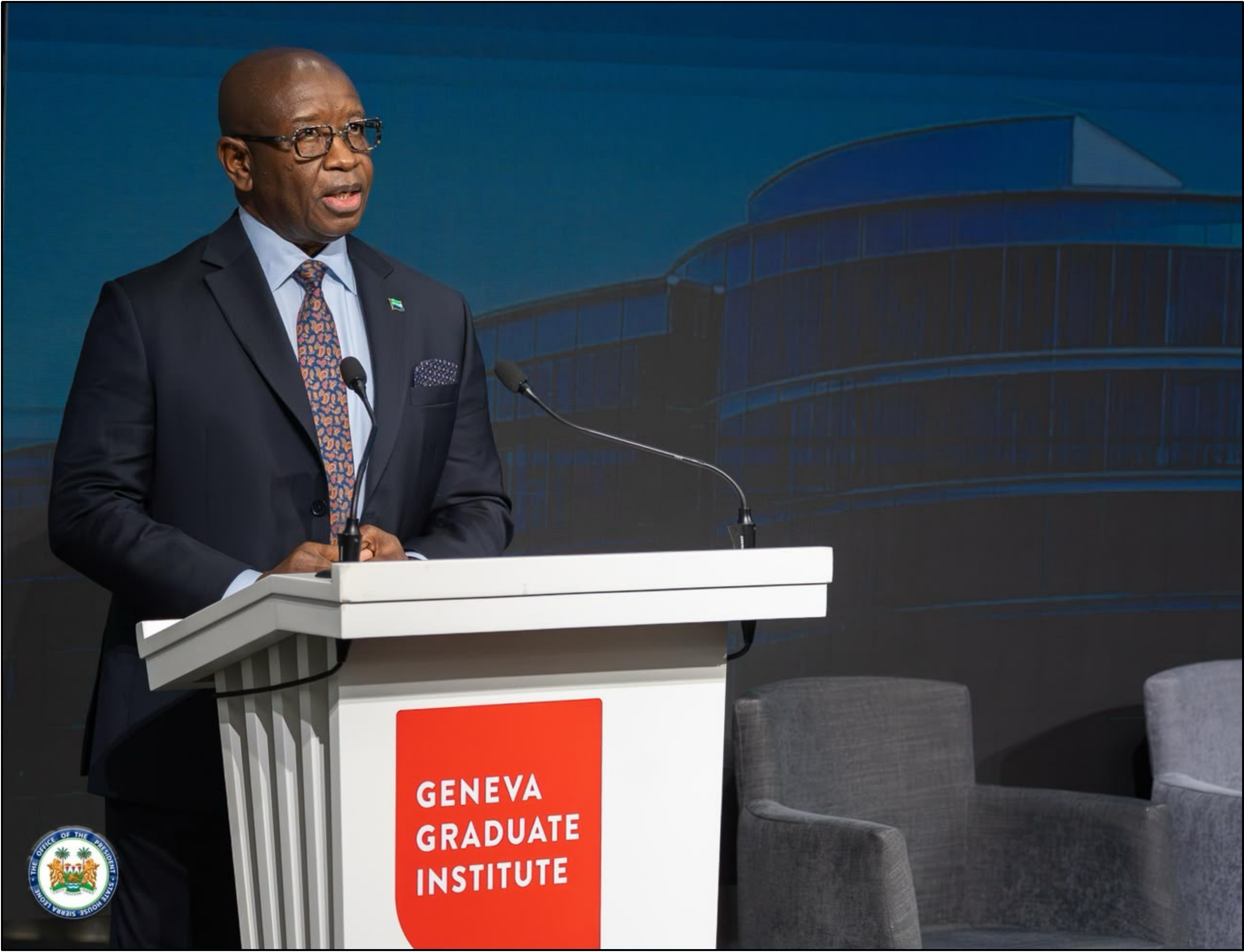
Sierra Leone’s President, Dr Julius Maada Bio, has highlighted five key priorities for achieving lasting peace in Africa during a keynote address at the Geneva Graduate Institute. Speaking on “Building Lasting Peace in Africa: The Catalytic Role of ECOWAS,” he stressed that peace goes beyond simply ending conflicts; it requires addressing the underlying conditions that foster them.
Biol emphasized the importance of stronger democratic institutions, preventive diplomacy, regional cooperation, people-focused security, and sustainable funding for African-led peace operations. Reflecting on his experiences as a former soldier and leader of Sierra Leone’s post-war recovery, he noted the country’s shift from relying on international peacekeeping to contributing to peace efforts elsewhere.
While he acknowledged that regional and international partners play a role in fostering peace, he insisted that true security must stem from national ownership, justice, and effective public institutions. “One of my priorities is to prevent conflicts from escalating,” he asserted, proposing a Regional Prevention Compact that would trigger mediation efforts at the first signs of crisis.
Bio further advocated for strengthening democratic institutions and accountable governance, citing Sierra Leone’s peaceful transitions of power in 2007 and 2018 as examples of stability that can be modelled elsewhere. He also called for greater regional cooperation, referring to “cooperative sovereignty” as a means for West African nations to jointly address security challenges, and emphasized the importance of dialogue with nations such as Burkina Faso, Mali, and Niger, while acknowledging that ECOWAS must learn from past errors.
He underscored the need for security strategies to focus on the well-being of people, advocating for more investment in youth opportunities to combat the root causes of conflict. Bio reiterated Sierra Leone’s support for reforming the United Nations Security Council, arguing for a fairer representation of Africa in decisions that impact peace and security globally.
“The best results of peacebuilding are the wars that never started, the elections that never were contested, the youth that found jobs, not guns,” he said. In closing, Dr Bio urged that peace should not only be measured by the absence of violence but also by the opportunities and security provided to individuals, particularly the youth, to build a brighter future.


